The skin forms the primary interface between the body and the environment. It protects the body from numerous external influences while helping maintain the body’s internal balance.
This protective function relies largely on a structure known as the skin barrier. Located in the most superficial layers of the skin, it plays an essential role in protecting against external aggressors and regulating skin hydration.
When this barrier functions properly, the skin generally appears supple, comfortable and balanced. Conversely, when it is weakened, the skin may become drier, more reactive or more sensitive to certain environmental factors.
Understanding how the skin barrier functions helps to better appreciate the skin’s needs and adopt skincare practices that are more respectful of its physiology.
What is the skin barrier?
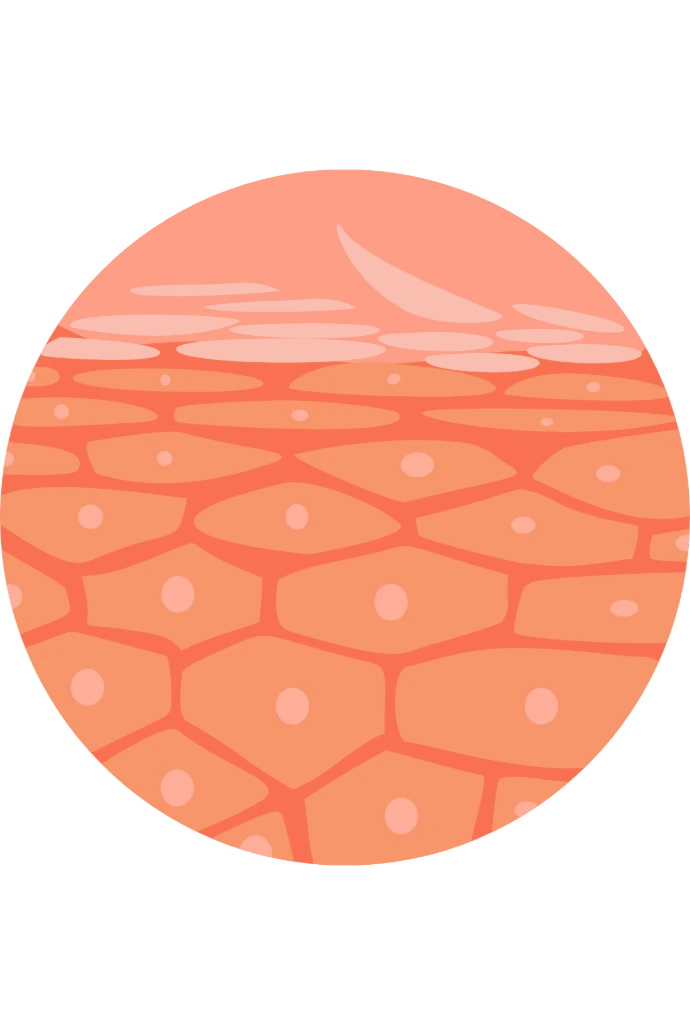
The skin barrier refers to the set of mechanisms that enable the skin to fulfil its protective function. It is mainly located in the outermost layer of the epidermis, called the stratum corneum.
This layer is composed of cells called corneocytes, which result from the progressive differentiation of epidermal cells during the natural process of skin renewal.
These cells are surrounded by a lipid matrix mainly composed of:
- ceramides
- fatty acids
- cholesterol.
This organisation is often described according to the “brick and mortar” model: corneocytes represent the bricks, while the intercellular lipids form the mortar.
This structure forms a relatively effective barrier against many external factors and contributes to limiting water loss through the skin (Proksch et al., 2008).
The role of skin lipids
Lipids present in the stratum corneum play a central role in barrier function.
Ceramides, fatty acids and cholesterol organise into lamellar structures that contribute to maintaining the cohesion of the stratum corneum. This lipid organisation limits exchanges between the inside of the skin and the external environment.
Changes in the composition or organisation of these lipids may influence the integrity of the skin barrier and the skin’s ability to retain water (Elias, 2005).
The regulation of skin hydration
The skin barrier also plays an essential role in the regulation of skin hydration.
Water present in the deeper layers of the skin naturally tends to evaporate toward the surface. This phenomenon is known as Transepidermal Water Loss (TEWL).
The structure of the stratum corneum and the organisation of skin lipids contribute to limiting this water loss.
When the skin barrier is altered, transepidermal water loss may increase, which may result in:
- a sensation of dryness
- reduced suppleness
- rougher skin.
Natural Moisturizing Factors
In addition to skin lipids, the stratum corneum also contains hygroscopic substances known as Natural Moisturising Factors (NMF).
These molecules, derived in particular from the breakdown of certain skin proteins, help maintain hydration within the corneocytes.
NMF therefore contribute to the suppleness and flexibility of the stratum corneum.
Factors that can influence the skin barrier
The skin barrier is not a static structure. It continuously evolves under the influence of various factors.
Environmental factors
The skin is constantly exposed to environmental influences such as:
- ultraviolet radiation
- atmospheric pollution
- climatic variations
- wind
- dry air.
These factors may temporarily disturb certain physiological parameters of the skin and influence barrier function.
Skincare habits
Certain practices may also affect the balance of the skin barrier when repeated excessively.
For example:
- overly aggressive cleansing
- excessively frequent exfoliation
- the use of products poorly suited to the skin’s sensitivity.
In some cases, these practices may temporarily weaken the stratum corneum and increase transepidermal water loss.
Skin barrier and skin sensitivity
Skin sensitivity is often associated with an alteration of barrier function.
When the barrier is weakened, certain substances may penetrate more easily into the superficial layers of the skin, which may promote sensations of discomfort or reactivity.
Several studies suggest that alterations in skin barrier function may be associated with increased cutaneous reactivity in some individuals (Berardesca et al., 2013).
The role of skin pH
Skin pH also contributes to maintaining the skin barrier.

The surface of the skin naturally has a slightly acidic pH, generally between 4.5 and 5.5. This acidity contributes in particular to:
- the organisation of skin lipids
- certain enzymatic activities of the skin
- the balance of the skin microbiome.
Changes in skin pH may influence certain biological mechanisms involved in barrier function (Lambers et al., 2006).
Preserving the balance of the skin barrier
The skin possesses natural mechanisms that help maintain its balance. However, certain practices may help preserve this balance on a daily basis.
For example:
- favouring gentle cleansers
- adjusting the frequency of exfoliation
- avoiding overly aggressive actions
- observing how the skin reacts.
An attentive and coherent approach to skincare may contribute to maintaining a more stable skin environment.
Conclusion
The skin barrier is a central element of skin physiology. It contributes in particular to:
- protecting the skin against external aggressors
- limiting transepidermal water loss
- maintaining skin balance.
Its integrity depends on numerous factors, including the organisation of skin lipids, skin pH and environmental influences.
Understanding these mechanisms makes it possible to adopt a skincare approach that is more respectful of the skin’s natural functioning and to favour practices that support the skin’s natural balance.
Scientific references
Proksch, E., Brandner, J. M., & Jensen, J. M. (2008). The skin: an indispensable barrier. Experimental Dermatology, 17(12), 1063–1072.
Elias, P. M. (2005). Stratum corneum defensive functions: an integrated view. Journal of Investigative Dermatology, 125(2), 183–200.
Berardesca, E., Farage, M., & Maibach, H. I. (2013). Sensitive skin: an overview. International Journal of Cosmetic Science, 35(1), 2–8.
Lambers, H., Piessens, S., Bloem, A., Pronk, H., & Finkel, P. (2006). Natural skin surface pH is on average below 5, which is beneficial for its resident flora. International Journal of Cosmetic Science, 28(5), 359–370.