Tingling sensations, feelings of warmth, or general cutaneous discomfort are increasingly discussed in the context of skincare. Many individuals report having sensitive skin, sometimes on a persistent basis, sometimes only under specific circumstances.
Sensitive skin is not considered a dermatological condition in itself. It is generally described as an increased reactivity of the skin to stimuli that would normally be well tolerated (Misery et al., 2016; Berardesca et al., 2013).
Understanding the underlying physiological mechanisms allows for a more attentive approach to skincare and helps to better identify the factors that may influence skin balance.
A widely reported condition
Several studies indicate that a significant proportion of the population reports having sensitive skin, with estimates often exceeding 40% to 60% depending on the population studied (Farage, 2019).
This perception may manifest through various sensations:
- tingling
- tightness
- sensations of warmth
- skin discomfort
- transient redness
These manifestations may appear in response to various factors such as:
- climatic changes
- certain cosmetic products
- environmental stress
- hormonal variations
In many cases, these sensations are experienced without visible changes in the skin.
The role of the skin barrier
The outermost layer of the skin, known as the stratum corneum, plays a fundamental role in protecting the body.
It is composed of:
- corneocytes (keratinised cells)
- intercellular lipids
- natural moisturising factors
This organisation helps limit:
- transepidermal water loss
- the penetration of external substances
- the impact of certain environmental factors
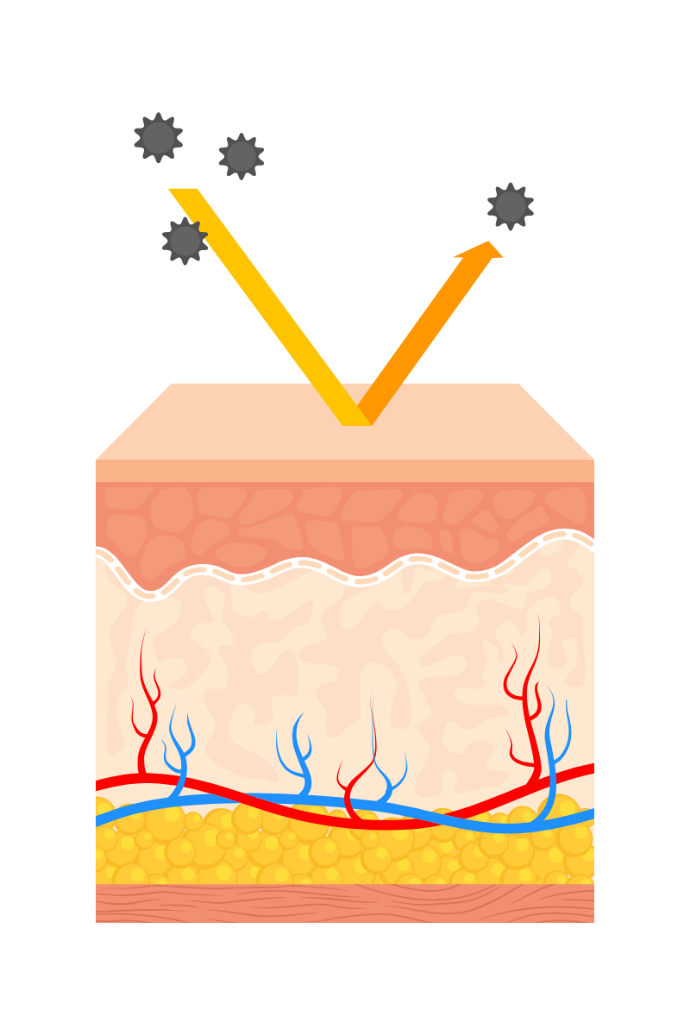
When this barrier is altered, the skin may become more permeable and more reactive. Several studies suggest that a reduction in barrier integrity may be associated with increased skin sensitivity (Berardesca et al., 2013).
A neurosensory dimension
The skin is also a sensory organ rich in nerve endings. Some research suggests that sensitive skin may be associated with increased reactivity of cutaneous nerve fibers.
In this context, certain stimuli—such as temperature variations or specific ingredients—may be perceived more intensely, leading to sensations such as tingling or warmth (Misery et al., 2016).
This neurosensory dimension helps explain why discomfort may be experienced even in the absence of visible signs of irritation.
Environmental influences
The skin is continuously exposed to its environment. Several factors may influence its balance and tolerance:
- ultraviolet radiation
- climatic variations
- atmospheric pollution
- wind
- dry air
These elements may contribute to temporary weakening of the skin barrier and to increased sensations of discomfort.
Some publications suggest that environmental factors, including air pollution, may influence skin balance.
The skin microbiome
The surface of the skin hosts a complex ecosystem of microorganisms known as the skin microbiome.
This microbiome is involved in:
- protection against certain external agents
- local immune balance
- maintenance of skin homeostasis
When this balance is disrupted, the skin may become more vulnerable to imbalances and sensations of discomfort.
Maintaining a skin environment that respects this ecosystem can help preserve its equilibrium.
The importance of skin pH
The surface of the skin naturally exhibits a slightly acidic pH, generally between 4.5 and 5.5.
This pH contributes to:
- the maintenance of the skin barrier
- the balance of the microbiome
- certain enzymatic functions of the skin
Repeated disruption of skin pH may influence skin balance and be associated with increased reactivity.
Skincare habits
Daily practices may also influence skin tolerance.
Certain habits can weaken the skin when repeated excessively:
- overly aggressive cleansing
- excessively frequent exfoliation
- layering multiple products
- using formulations that are not well tolerated by certain skin types
Conversely, approaches prioritising tolerance and skin balance may help maintain a more respectful environment for the skin.
Exfoliation and skin sensitivity
Exfoliation aims to remove dead cells from the surface of the skin and support cellular renewal.
However, when too intensive, it may alter the skin barrier and increase sensitivity.
Different exfoliation methods exist:
- mechanical exfoliation
- chemical exfoliation
- enzymatic exfoliation
Some methods aim to act on the surface of the skin without mechanical abrasion, in order to limit the risk of irritation.
A thoughtful approach to skincare
Sensitive skin often calls for simple and consistent routines.
In many cases, a minimal approach may be sufficient:
- gentle cleansing
- appropriate hydration
- protection against external aggressors
Consistency and coherence in daily habits may play an important role in maintaining skin balance.
Conclusion
Sensitive skin is not a strictly defined skin type. Rather, it corresponds to a state of increased reactivity that may result from multiple factors:
- alteration of the skin barrier
- neurosensory sensitivity
- environmental factors
- skincare habits
- microbiome balance
Understanding these mechanisms helps to adopt a more respectful approach to skin function and to favor formulations developed with a focus on tolerance and balance.
Scientific references
Misery, L., Loser, K., & Ständer, S. (2016). Sensitive skin. Journal of the European Academy of Dermatology and Venereology, 30(S1), 2–8.
Berardesca, E., Farage, M., & Maibach, H. (2013). Sensitive skin: an overview. International Journal of Cosmetic Science, 35(1), 2–8.
Farage, M. A. (2019). The prevalence of sensitive skin. Frontiers in Medicine, 6, 98.